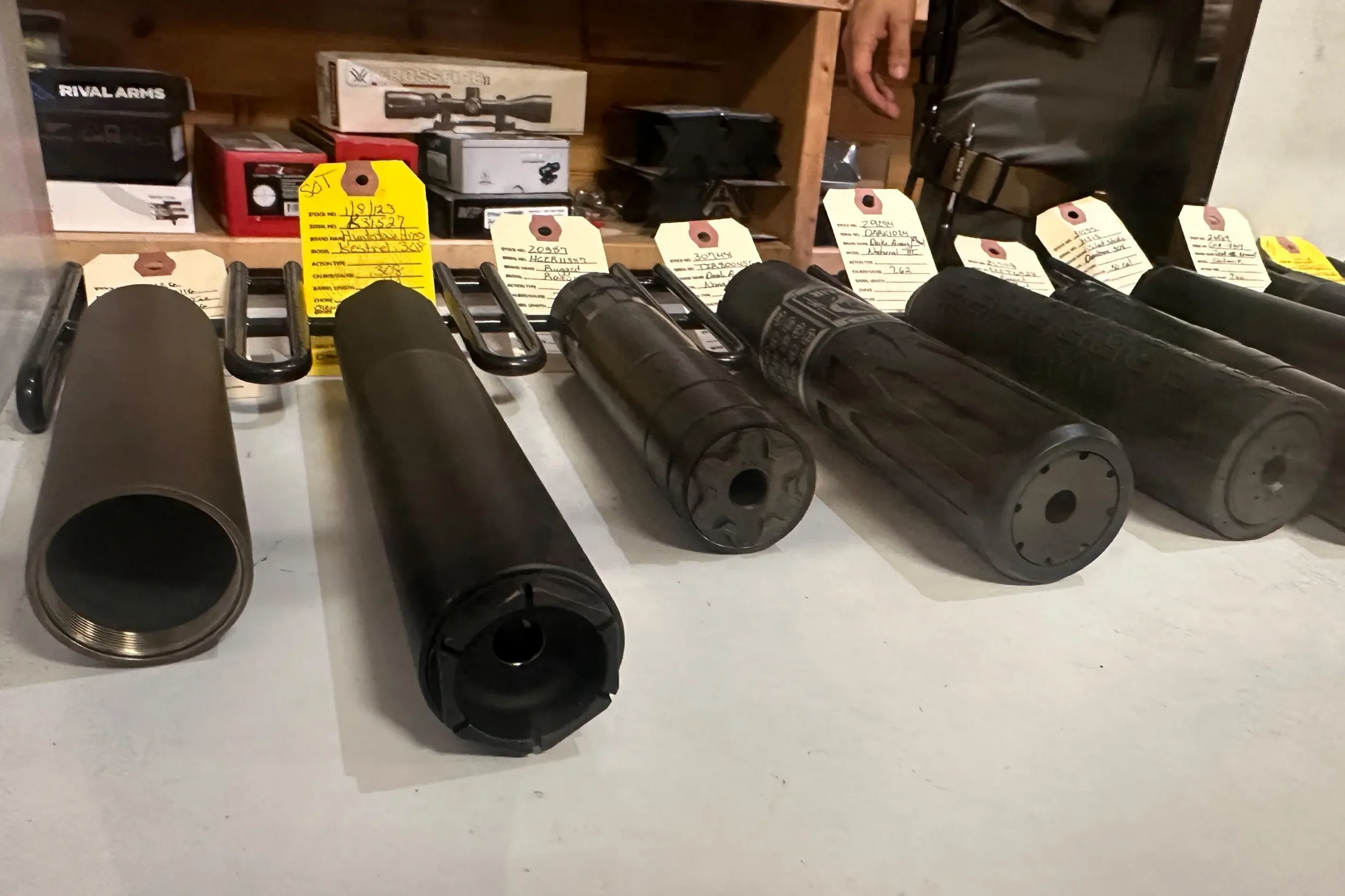
Gun suppressors are flying off gun store shelves in reaction to recent changes in laws and a federal court ruling on registration requirements.
The One Big Beautiful Bill Act reduced the federal National Firearms Act (NFA) tax on suppressors from $200 to $0, effective January 1.
In August, a second win for the Second Amendment came when a federal judge in Texas ruled the NFA’s registration requirements could no longer be enforced against the plaintiffs in the case: Silencer Shop, Gun Owners of America and 15 states. Silencer Shop said the order currently allows suppressors to be transferred without NFA registration in 27 states, including Alabama.
However, the ATF (Bureau of Alcohol, Tobacco, Firearms and Explosives) has not yet updated procedures in response to the court ruling, so gun shops remain cautious and continue the federal registration process.
T&T Guns and Ammo in Foley is already selling 10 to 30 suppressors each week.
“We’ve seen a tremendous uptick in the amount of sales that we’ve been conducting with our shop,” said store manager Drew Hemby. “We’re up probably 200% to 300% in sales.”
Hemby hopes to receive clear guidance from the ATF in mid-October. Until then, the store is still following registration requirements.
The NFA process requires Form 4, which includes personal information, a photo and fingerprints. The store has a Silencer Shop kiosk, where the forms are submitted digitally to the ATF. That will all change if the store gets the green light to stop using Form 4.













State Auditor Andrew Sorrell owns three gun stores in Alabama. Gold, Guns and Guitars has continued selling suppressors with Form 4 because although he believes the registry is unconstitutional, he has yet to receive clarity from the federal government.
“We are begging our ATF agent to give us guidance, and they have not done it,” Sorrell said. “So, until they do, we don’t know what to do. We are hopelessly stuck in the middle. Now, constitutionally, I believe there should be no such thing as class three. Other countries have suppressors that are not restricted to even purchase. It’s an accessory. It’s not a gun.”
Alabama did not join the Texas lawsuit, so Sorrell said he is not willing to take any chances.
“If a customer purchases a suppressor from my store, are they my customer or are they the customer of Silencer Shop? I don’t know. I don’t have any clarification on that, and until we get it, I’m not willing to risk the 20 employees who work for me and the three gun stores that we own and operate in Alabama.”
Sorrell said he hopes the issue makes its way to the United States Supreme Court so it can lead to a nationwide change.
“The entire NFA tax stamp and gun registry database and all of that just needs to go the way of the dinosaur and just needs to be completely abolished,” Sorrell added.
T&T Guns and Ammo has been selling suppressors since 2019. Hemby said approval times have greatly reduced from six months to a year, to 24 hours to three weeks. Anticipating even greater demand, the store is stockpiling more suppressors, ordering up to 50 per week.
Lawmakers said that despite Hollywood’s portrayal of suppressors as tools of criminals, there is no statistical evidence linking suppressors to criminal activity. Suppressors are used as hearing protection devices.
“I’ve long been a supporter and a proponent of what’s called the Hearing Protection Act, which says that you should be able to purchase a suppressor without the Form 4 process,” Sorrell said. “It’s very loud to shoot a gun. People ought to be able to put a suppressor on it and shoot it without earmuffs.”
Hemby said suppressors can drop rifle shots from 170 decibels to below 130 decibels. The Occupational Safety and Health Administration (OSHA) sets the threshold at 140 decibels for exposure to impact noise.
“So, the purpose of your suppressor is going to be just to drop the volume down to make it safer for you,” Hemby explained. “It’s going to take away all the boom and concussion, especially on larger caliber suppressors.”
With the politics surrounding suppressors, he hopes people hear from the experts before taking a side on the issue.
“Don’t take information at face value from what you read online,” Hemby added. “Go talk to your local gun shop people, talk to law enforcement, who are going to know these laws and rules better than politicians, because there’s a lot of potential misinformation.”
Suppressors are sold at a wide range of prices. The materials, weight and brand determine the cost. As more manufacturers begin to produce suppressors, Hemby said technology is changing.
“We’re seeing companies like Taurus, who has never made suppressors before; they’ve actually now made their own TX 22 suppressor to go along with their threaded barrel .22 pistols,” Hemby said. “We’ve already seen a new uptick in companies that have started coming out with them but I think that once the official rules drop, we’re going to see even more companies get into starting to produce suppressors.”
Hemby said he hasn’t noticed a significant increase in suppressor costs from manufacturers in response to the changes.
About The Author